You don’t always need a huge advertising budget to get noticed.
Sometimes, a clever idea in the right place at the right time can generate more attention than a traditional advertising campaign.
That’s the idea behind guerrilla marketing.
Instead of competing purely through advertising spend, guerrilla marketing focuses on creativity, surprise, relevance, and memorable experiences. The objective is simple: create something people notice, remember, and talk about.
What Is Guerrilla Marketing?
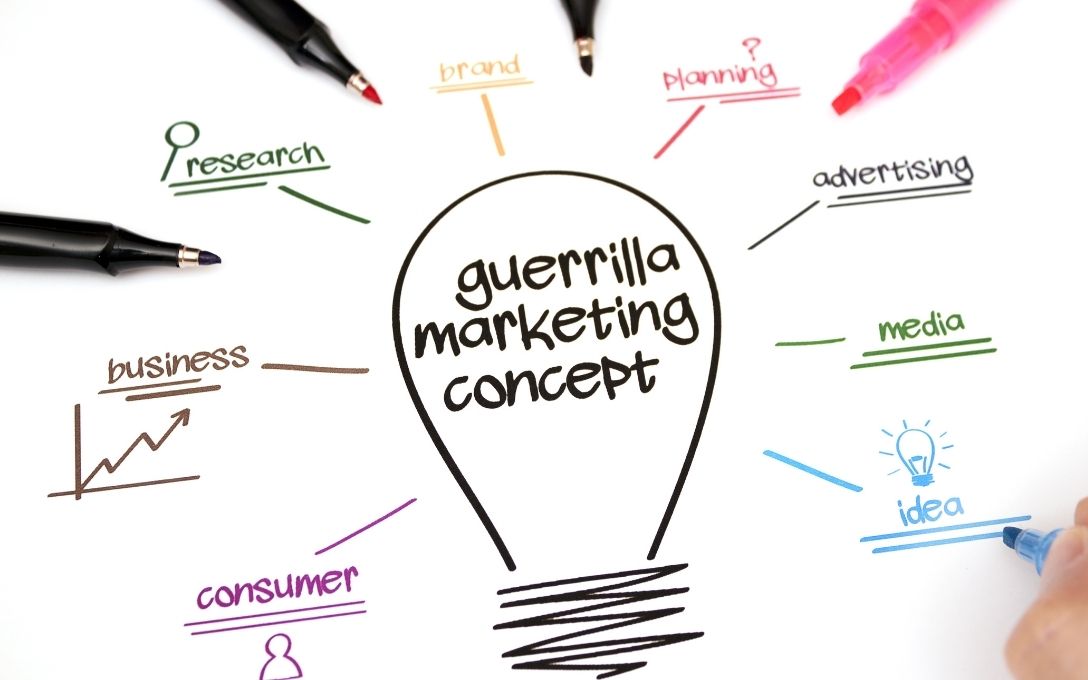
Guerrilla marketing is a marketing approach that uses unconventional, creative, and often unexpected ideas to generate attention.
Unlike traditional advertising, which often relies on buying media space, guerrilla campaigns can use:
- Public spaces
- Street installations
- Unexpected brand activations
- Creative signage
- Social media moments
- Pop-up experiences
- Public stunts
- Product placements
- Interactive experiences
- Community events
The idea isn’t necessarily to spend more.
It’s to make the idea more noticeable.
Why Does Guerrilla Marketing Work?
People are surrounded by advertising every day.
They see:
- Billboards
- Sponsored posts
- Search ads
- Display banners
- Influencer promotions
- Video ads
- Email promotions
As consumers become more familiar with traditional advertising formats, unexpected marketing experiences can stand out.
Surprise Creates Attention
Imagine walking through a shopping district and seeing a normal advertisement.
You might ignore it.
Now imagine seeing something completely unexpected that makes you stop and look twice.
That moment of surprise can create attention.
And attention can lead to:
Attention → Curiosity → Sharing → Conversation → Brand Awareness
Small Ideas Can Create Big Attention
Guerrilla marketing doesn’t necessarily require a massive production budget.
The strongest campaigns often start with a simple observation.
Look for Everyday Opportunities
Ask:
- Where does our audience spend time?
- What do they normally see there?
- What could we change?
- What would make them stop?
- What would make them take a photo?
- What would make them tell someone else?
- How could our product become part of the experience?
A small creative idea can become powerful when it interacts with the audience’s environment.
The Power of the Unexpected
Traditional advertising often tells consumers exactly what to expect.
A billboard looks like a billboard.
A sponsored post looks like a sponsored post.
Guerrilla marketing can disrupt those expectations.
Create a Double-Take Moment
The goal isn’t simply to make something strange.
It should create a moment where people think:
“Wait… what is that?”
That moment creates curiosity.
For example, a brand could use:
- An unusual installation
- A surprising message
- A creative use of public space
- An unexpected product demonstration
- A visual illusion
- A humorous interaction
- A temporary transformation
The creative idea should still connect clearly to the brand.
Attention without relevance is just noise.
Make the Idea Shareable
One of the biggest advantages of guerrilla marketing today is that the campaign doesn’t have to stay in the physical location where it happens.
Someone sees it.
Someone takes a photo.
Someone posts it.
Someone else shares it.
Suddenly, a local activation can become social content.
Design for the Camera
When planning a guerrilla campaign, ask:
“What will this look like when someone photographs it?”
Consider:
- Strong visual composition
- Recognizable branding
- Short, memorable messaging
- Interesting angles
- Human interaction
- A clear reason to take a photo
- A natural social media moment
The physical experience becomes the original content, while social media becomes the distribution engine.
Guerrilla Marketing and Social Media Work Together
A successful guerrilla campaign can generate content far beyond the original activation.
For example:
Physical Activation → Customer Photos → Instagram → Reels → TikTok → News Coverage → Organic Search → Brand Awareness
This makes guerrilla marketing particularly interesting in the social media era.
A creative idea doesn’t have to stay offline.
It can become a content ecosystem.
For more ideas on building engaging content and creative that captures attention, explore Practical Tips for Building High-Performing Ad Creative.
The same principles—strong hooks, visual storytelling, audience relevance, and creative experimentation—can help turn a guerrilla activation into content people want to watch and share.
Create Experiences, Not Just Advertisements
One of the biggest differences between traditional advertising and guerrilla marketing is the role of the audience.
Traditional advertising often asks people to watch.
Guerrilla marketing can invite people to participate.
Turn the Audience Into Part of the Campaign
You can encourage participation through:
- Interactive installations
- Photo opportunities
- Challenges
- Games
- Product demonstrations
- Polls
- QR codes
- Social media activities
- Live experiences
When people participate, they aren’t just seeing the campaign.
They’re becoming part of it.
Connect the Idea to the Brand
Creativity alone isn’t enough.
A campaign can become popular while people forget who created it.
That’s a problem.
The Brand Should Have a Reason to Be There
Before launching a guerrilla campaign, ask:
- Why is our brand doing this?
- What does the idea have to do with our product?
- Does the experience communicate our brand personality?
- Will people remember the brand after seeing the campaign?
- Can someone understand the connection without an explanation?
The strongest guerrilla marketing ideas don’t feel like random stunts.
The creative idea and the brand idea feel connected.
Word of Mouth Marketing: Why People Trust People More Than Ads
Guerrilla Marketing Can Build Word of Mouth
One of the most valuable outcomes of an unconventional campaign is conversation.
People might:
- Talk about it with friends
- Post it on social media
- Tag someone
- Share a Reel
- Send it through WhatsApp
- Discuss it online
- Write about it
- Create their own version
This connects guerrilla marketing directly to word-of-mouth marketing.
Instead of the brand being the only voice, the audience becomes part of the distribution.
The goal becomes:
Create something people want to talk about.
Use Creativity to Compete With Bigger Brands
Smaller businesses often assume they cannot compete with companies that have larger marketing budgets.
But attention isn’t always proportional to spending.
A larger budget can buy more impressions.
A clever idea can sometimes generate more conversation per impression.
Small Brands Can Focus on Agility
Smaller companies can often move quickly.
They can:
- Test ideas
- React to trends
- Experiment with formats
- Partner with local businesses
- Create community activations
- Respond to cultural moments
- Personalize experiences
The advantage isn’t necessarily having more resources.
It can be moving faster and thinking differently.
Guerrilla Marketing Still Needs Strategy
Creative campaigns can fail if the strategy behind them is weak.
A clever activation won’t automatically generate customers.
You still need to understand:
- Your target audience
- Your objective
- Your brand positioning
- Your message
- Your distribution strategy
- Your measurement plan
- Your conversion journey
This is why campaign planning matters before execution.
Our guide on Why Most Marketing Campaigns Fail Before They Launch explores the foundations that marketers should address before launching campaigns, including audience research, positioning, creative strategy, landing pages, tracking, and KPIs.
A guerrilla campaign may look unconventional, but the marketing fundamentals behind it still matter.
From Attention to Qualified Leads
Getting attention is only one part of marketing.
If the campaign is designed to generate business, you need to think about what happens after someone discovers the brand.
Build the Next Step
A guerrilla activation could direct people to:
- A landing page
- QR code
- Social media profile
- WhatsApp conversation
- Booking page
- Product page
- Special offer
- Lead form
For campaigns focused on lead generation, the objective should be more than maximizing attention.
You want to attract people who are actually relevant to the business.
Our guide on How to Get Qualified Leads explores strategies for attracting higher-quality prospects through targeted messaging, content, SEO, audience targeting, and conversion-focused campaigns.
Guerrilla Marketing Can Grow Your Social Audience
A memorable offline experience can also become an opportunity to grow your online community.
For example:
Street Activation → QR Code → Instagram Profile → Follow → Content → Community
The key is giving people a reason to stay connected after the campaign ends.
Give People a Reason to Follow
That reason could be:
- Exclusive content
- Behind-the-scenes videos
- Future events
- Competitions
- Product updates
- Community content
- Special experiences
For more ideas on building an engaged audience, read How to Increase Your Social Media Followers Organically.
The goal shouldn’t simply be to collect followers.
Build an audience that actually wants to hear from your brand.
Think About the Full Customer Journey
A person might discover your guerrilla campaign offline.
Then they search for the brand.
They find your Instagram account.
They visit your website.
They read reviews.
They send a WhatsApp message.
They eventually become a customer.
The Journey Isn’t Linear
The customer journey might look like:
Guerrilla Campaign → Social Media → Google → Website → Reviews → WhatsApp → Lead → Customer
This is why guerrilla marketing should connect with the rest of your marketing ecosystem.
Our article The New Marketing Funnel Is No Longer Linear explores how customers move between different digital and offline touchpoints before making a purchase decision.
How to Create a Guerrilla Marketing Idea
If you’re planning your own campaign, start with the audience rather than the execution.
Step 1: Identify the Audience
Who are you trying to reach?
Step 2: Identify the Environment
Where will they encounter the campaign?
Step 3: Identify the Opportunity
What do people normally see or experience there?
Step 4: Create the Disruption
What could you do differently?
Step 5: Connect It to the Brand
Why does your brand have a reason to be there?
Step 6: Make It Shareable
Would someone take a picture or video?
Step 7: Create the Next Step
Where should interested people go afterward?
Step 8: Measure the Results
Track relevant metrics such as:
- Reach
- Impressions
- Social mentions
- Shares
- Engagement
- Website traffic
- Branded searches
- QR code scans
- Leads
- Conversions
The Best Guerrilla Marketing Doesn’t Feel Like Advertising
That’s perhaps the biggest lesson.
People don’t necessarily want another advertisement interrupting their day.
But they may stop for something unexpected.
They may photograph it.
They may laugh.
They may participate.
They may tell a friend.
They may post it.
And that’s where the real power of guerrilla marketing comes from.
The audience becomes part of the campaign.
Final Thoughts
Guerrilla marketing proves that big attention doesn’t always require a big budget.
It requires a strong understanding of your audience, a creative idea, the right environment, and a reason for people to care.
The formula can be simple:
Small Idea + Right Moment + Right Audience + Strong Execution = Big Attention
But attention is only the beginning.
The strongest campaigns turn attention into conversation, conversation into interest, and interest into meaningful customer action.
Because in a world filled with advertisements, sometimes the most effective way to get noticed isn’t to advertise louder.
It’s to do something people can’t help but notice.