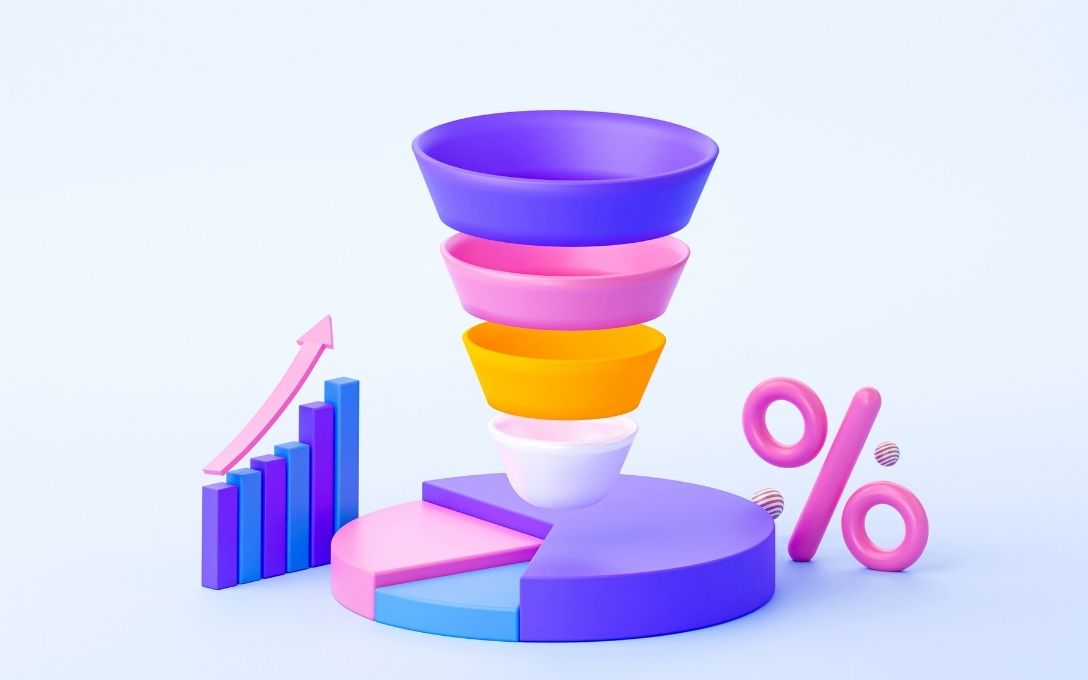
A marketing funnel helps you understand how potential customers move from discovering your brand to becoming paying customers. But having a funnel in place isn’t enough. You need to continuously optimize each stage to attract the right audience, build trust, and turn interest into action.
Whether you’re running paid advertising, social media campaigns, or content marketing, optimizing your funnel can help you reduce wasted spend and generate better-quality leads.
Here are seven practical tips to optimize your marketing funnel.
Key Takeaways: Optimizing Your Marketing Funnel
- Are we attracting the right audience at the top of the funnel?
- Is our messaging relevant at every stage of the customer journey?
- Where are potential customers losing interest or dropping off?
- Are we making it easy for prospects to move from consideration to action?
- Are we using data to identify and fix conversion bottlenecks?
- Are our landing pages and CTAs aligned with customer intent?
- Are we continuously testing and improving each stage of the funnel?
1. Understand Your Target Audience
The foundation of any successful marketing funnel is understanding who you are trying to reach.
Before launching campaigns, identify your target audience’s needs, challenges, interests, and buying behavior. This allows you to create messaging that speaks directly to them.
Your audience may also differ at each stage of the funnel. Someone discovering your brand for the first time needs different information from someone who is already comparing your services.
The more clearly you understand your audience, the easier it becomes to create relevant campaigns and content.
2. Create Awareness With the Right Content
The top of the funnel is about attracting potential customers and introducing them to your brand.
At this stage, focus on content that educates, informs, or solves a problem rather than immediately pushing for a sale.
Examples include:
- Blog articles
- Social media content
- Educational videos
- Guides and resources
- Awareness campaigns
- Search campaigns targeting informational queries
Your advertising creative also plays an important role. Following Practical Tips for Building High-Performing Ad Creative can help you create ads that capture attention and encourage users to enter your funnel.
3. Make Every Stage of the Funnel Relevant
Not every visitor is ready to convert immediately.
A strong funnel provides the right information based on where the user is in their journey.
For example:
Awareness: Introduce the problem and your brand.
Consideration: Explain your solution, benefits, expertise, and credibility.
Conversion: Make it easy for the user to book, purchase, contact you, or submit a form.
Understanding Modern Marketing Funnel is particularly important because users can enter and exit your funnel at different stages and interact with multiple channels before converting.
4. Optimize Your Landing Pages
Once someone clicks your ad or content, the landing page needs to continue the same message and guide the visitor toward the next step.
Your landing page should have:
- A clear headline
- Relevant content
- Strong trust signals
- A clear call-to-action
- Simple navigation
- Mobile-friendly design
- A fast loading speed
Even a great campaign can struggle if the landing page creates friction.
For more practical advice, check out 5 Tips for Building a High-Converting Landing Page.
5. Make Lead Generation Simple
If your goal is to generate leads, don’t make the process unnecessarily complicated.
Keep forms short and only request information you actually need. Make your CTA clear and ensure users understand what will happen after submitting their details.
You should also focus on lead quality, not just lead volume. Getting hundreds of leads isn’t useful if most of them aren’t relevant or don’t convert.
For more strategies, explore How to Get Qualified Leads?.
6. Measure the Right Metrics
You can’t optimize your marketing funnel without knowing what’s working.
Track performance at every stage, including:
Impressions → Clicks → Landing Page Visits → Leads → Bookings → Customers
Look beyond surface-level metrics such as clicks and impressions. Understand which campaigns, channels, and audiences are actually contributing to business results.
7. Test, Learn, and Improve Continuously
Marketing funnel optimization is an ongoing process.
Test different:
- Ad creatives
- Headlines
- Offers
- Landing page layouts
- CTAs
- Audience segments
- Forms
- Follow-up messages
Use your results to understand what works best and continuously improve your campaigns.
Don’t assume that a campaign is successful simply because it generates a high number of leads. Look at the complete journey from the first interaction to the final conversion.
Final Thoughts
Optimizing your marketing funnel is about creating a smoother journey for your audience while improving the efficiency of your marketing efforts.
Start by understanding your audience, create relevant content, optimize your landing pages, simplify lead generation, track meaningful metrics, and continuously test your campaigns.
Most importantly, don’t look at each marketing channel in isolation. Your ads, content, landing pages, social media, and follow-up strategy should work together to move potential customers toward conversion.
A well-optimized funnel doesn’t just generate more leads it helps generate better leads and stronger business results.